
A patient and parent guide from our physiotherapy practice
Scoliosis is one of those words that can feel overwhelming the moment a doctor, school nurse, or physio first mentions it. Questions come fast: What does it mean? Will it get worse? Does my child need surgery? Can anything actually help?
This guide is written to answer those questions clearly and honestly. It draws on the most current clinical evidence and on training in the PSSE-Schroth method — one of the most advanced, evidence-based physiotherapy approaches to scoliosis management available today.
The good news: with the right knowledge, the right assessment, and the right treatment at the right time, the vast majority of people with scoliosis can be managed well — without surgery.
What Is Scoliosis?
The word scoliosis comes from the ancient Greek “skolios” — meaning curved or crooked. But the clinical reality is more complex than a simple side-bend.
According to the Scoliosis Research Society (SRS), scoliosis is a lateral deviation of the spine measuring greater than 10 degrees on X-ray, accompanied by rotation. The international rehabilitation society SOSORT defines it more fully as a complex, three-dimensional deformity of the spine and trunk, which appears in apparently healthy individuals and can progress in relation to multiple factors — particularly during periods of rapid growth.
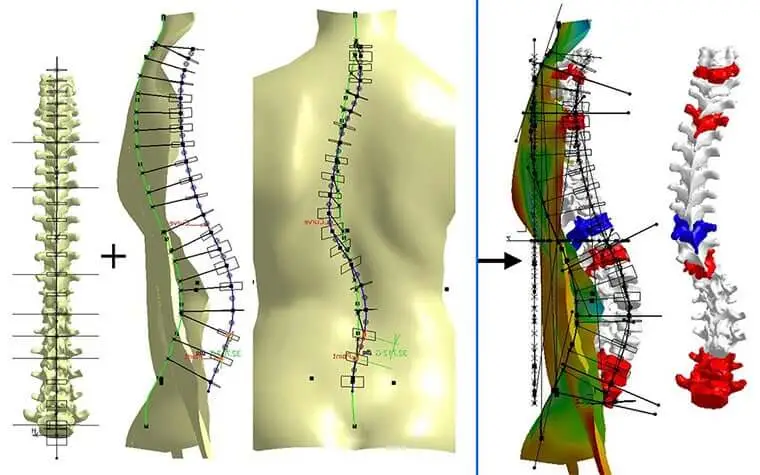
That three-dimensional component is critical. Scoliosis is not simply a sideways curve you can see in a diagram. The spine simultaneously curves sideways, rotates on its vertical axis, and shifts the shape of the rib cage and trunk. This is why scoliosis is visible in posture, in rib prominence, and in shoulder and hip asymmetry — and why effective treatment must address all three planes of movement.
There are two main categories of spinal curvature in the PSSE classification system:
- Scoliosis: a sideways and rotational deformity of the spine. The PSSE-Schroth system identifies 8 distinct curve types.
- Kyphosis: a forward-rounded and rotational deformity, presenting as an exaggerated rounding of the upper back. PSSE identifies 3 types.
Different curve types require different treatment approaches. This is why a thorough, individualised assessment is the essential starting point for all effective scoliosis care.
Who Gets Scoliosis — and When?
Scoliosis can affect anyone. There is no single known cause, and it occurs across all backgrounds, body types, and activity levels. Approximately 2–3% of children and adolescents are affected — most curves are mild and do not require surgery, but the condition is more common than many people realise.
The most common form is Adolescent Idiopathic Scoliosis (AIS). “Idiopathic” means the cause is unknown. Research suggests a likely genetic component, but no single gene or trigger has been identified. What is clear is that scoliosis is not caused by:
- Poor posture
- Heavy school bags or backpacks
- Sitting incorrectly
- Specific sports or physical activities
These are persistent myths that create unnecessary guilt in families. The spine develops a scoliotic curve through a complex interaction of growth, bone structure, muscle, and nervous system factors that science continues to investigate.
The Growth Connection
The peak risk period for scoliosis progression is the adolescent growth spurt — the phase of fastest skeletal development, which occurs at different ages for different children. This is the window when most scoliotic curves are first noticed, and when existing curves are most likely to worsen rapidly. Early identification during this phase gives patients and families the greatest range of treatment options.
It is equally important to know that scoliosis in adults warrants the same attention. Growth-related changes, degeneration, and osteoporosis can all cause adult curves to progress over time. Adult scoliosis is not simply a childhood problem that can be left behind.
Why Does a Painless Curve Still Matter?
One of the most common responses when scoliosis is first diagnosed is: “But it doesn’t hurt. So why do we need to do anything about it?”
Most adolescents with idiopathic scoliosis have little to no pain, especially early on. Pain is not a reliable indicator of how significant a curve is, or whether it is progressing.
The real concern is what happens when a curve continues to grow unchecked:
- Once a curve passes a critical size, the risk of further progression increases significantly — even after growth has ended.
- Larger curves affect the shape and space of the chest cavity, which can compromise breathing capacity and lung function over time.
- Significant spinal deformity impacts posture, body image, and quality of life.
- At severe angles (generally above 40–45 degrees), surgical intervention may become the only effective option.
The goal of early, well-timed management is not to treat pain — it is to prevent the curve from reaching the point where these complications become a real concern. Getting ahead of progression, particularly during the growth years, is what gives patients and families the most options.
How Is Scoliosis Measured and Classified?
Scoliosis is classified primarily by the size of the curve, measured on X-ray using the Cobb angle — the angle formed between the most tilted vertebrae at the top and bottom of the curve. This is the gold-standard measurement used by clinicians and researchers worldwide.
Cobb Angle Classifications
Functional imbalance:Cobb angle below 10° — not classified as structural scoliosis, but worth monitoring
Mild scoliosis:Cobb angle 10°–24°
Moderate scoliosis:Cobb angle 25°–40°
Severe scoliosis:Cobb angle above 40°
Understanding where a curve falls on this scale is essential: it informs prognosis (the likelihood of progression) and guides treatment decisions. The decision between observation, physiotherapy, bracing, or surgery is made by weighing curve size against growth stage, curve type, and individual risk factors.
For kyphosis, the normal thoracic range sits between 20–45 degrees (per SRS guidelines). Beyond this range, kyphosis is classified as clinically significant and requires assessment and management.

How Is Scoliosis Diagnosed?
Scoliosis can be identified through a range of assessments, from a simple home screen to detailed imaging. The process typically moves from simplest to most detailed:
- The Adams Forward Bend Test
The Adams test is the most widely used initial screening for scoliosis, and it costs nothing. The person bends forward from the waist with arms hanging freely while an observer views from behind. A rib or lumbar prominence on one side — the characteristic ‘hump’ — indicates potential spinal rotation consistent with scoliosis.
This can be done at home, at school, or in the clinic in under a minute. If there is any concern following this test, it is worth seeking a professional assessment.
- Scoliometer Measurement
A scoliometer is a small clinical tool that quantifies trunk rotation in degrees during the Adams test. It provides a more objective surface measurement than visual inspection alone and is a standard screening tool in physiotherapy.
- X-ray with Cobb Angle Measurement
When scoliosis is clinically suspected, a standing full-spine X-ray is the gold-standard diagnostic tool. The Cobb angle is measured from the images to classify the curve precisely. This measurement guides treatment decisions and tracks change over time.
- Additional Assessment Tools
Depending on the clinical picture, assessment may also include:
- The SRS-22 questionnaire — a validated patient-reported outcome measure covering pain, function, self-image, and mental health
- Clinical photography — for tracking postural change over time
- Surface topography — technology that maps the shape of the back without radiation
- CT or MRI scans — for cases where neurological involvement, congenital abnormality, or unusual curve patterns require further investigation
More detailed testing carries more cost and time. This is exactly why we start with the simplest, most accessible tools — and escalate only when clinically indicated.
Six Common Myths — Set Straight
Misinformation about scoliosis is widespread. Here are the six myths we encounter most often:
Myth 1: “Scoliosis is rare.”
Scoliosis affects approximately 2–3% of children. Most curves are mild and manageable, but the condition is far more common than many people expect.
Myth 2: “Bad posture or heavy school bags cause it.”
Idiopathic scoliosis has an unknown cause, likely involving genetic factors. It is not caused by how a child sits, stands, or what they carry. Attributing scoliosis to these factors creates unnecessary guilt and distracts from effective management.
Myth 3: “It must be painful.”
Most adolescents with idiopathic scoliosis experience little to no pain — particularly in the early stages. This is one of the reasons scoliosis often goes undetected without routine screening. Absence of pain does not mean absence of progression.
Myth 4: “A brace will straighten the spine.”
A brace’s clinical role is to prevent the curve from worsening during the growth years — not to reverse it. Brace treatment, especially combined with scoliosis-specific physiotherapy, has strong evidence for reducing progression and the need for surgery.
Myth 5: “Braced children cannot play sport.”
Activity is actively encouraged for children with scoliosis. Many remove their brace during sport, and continued movement is an important part of managing the condition. Physical activity supports muscle strength, bone health, and overall wellbeing.
Myth 6: “Specific exercises will cure the scoliosis.”
Scoliosis-specific physiotherapy — particularly the PSSE-Schroth method — has strong evidence for slowing progression, improving posture and symmetry, and enhancing quality of life. But it does not reverse an established structural curve. The goal is optimal management: keeping the curve stable, improving function, and avoiding the need for more invasive treatment.
Treatment Options: What Happens If I Have Scoliosis?
The right treatment depends on the size and type of the curve, the patient’s age and growth stage, and how rapidly the curve is progressing. In most cases there are three pathways. The goal of early, attentive management is always to achieve the best outcome at the most conservative level possible.
- PSSE-Schroth Physiotherapy
Physiotherapeutic Scoliosis Specific Exercises (PSSE) — and specifically the Schroth-based approach — are the recommended first line of active treatment for adolescent idiopathic scoliosis according to SOSORT and the SRS. PSSE is individualised to each patient’s specific curve type, combining supervised clinic sessions with a home exercise programme. SOSORT guidelines are clear: exercise therapy is the first step to treat scoliosis and prevent progression or bracing — not a last resort.
- Bracing
Bracing is recommended for moderate curves during the active growth phase, typically Cobb angles in the 25–40 degree range. The brace holds the spine in a corrected position while the child is still growing. The landmark BRAIST randomised controlled trial confirms that bracing is effective at preventing curve progression. The combination of bracing and PSSE physiotherapy consistently produces the best outcomes, with multiple studies reporting success rates above 80%.
- Surgery
Surgery — typically spinal fusion or a non-fusion technique — is reserved for severe curves (generally above 40–45 degrees) or rapidly progressing curves that have not responded to conservative treatment. It is a significant intervention. The primary aim of early, proactive physiotherapy and bracing management is to avoid ever reaching the surgical threshold.
What Is PSSE-Schroth? How Does It Actually Work?
The Schroth method was originally developed by Katharina Schroth in the early twentieth century and has evolved through multiple evidence-based schools into what is now called PSSE — Physiotherapeutic Scoliosis Specific Exercises. The PSSE-Schroth method, developed by physiotherapist and researcher Nikos Karavidas, represents the most current evolution of this approach, integrating innovations in classification, correction principles, and exercise design.
Unlike generic physiotherapy or general exercise, PSSE-Schroth is built around each patient’s specific curve type. The therapist first classifies the curve in three dimensions, then designs a programme targeting the corrections that curve uniquely requires.
The Four Principles of 3D Correction
- 3D Auto-Correction: The patient learns to lengthen and lift the spine, correct pelvic alignment, and adjust posture in the side-to-side and front-to-back planes simultaneously. This is active, conscious correction — not passive stretching.
- Corrective / Rotational Breathing: The collapsed or compressed areas of the rib cage are targeted with specific breathing techniques. On the inhale, the patient expands into the sunken areas; on the exhale, that correction is maintained. Over time, this helps reshape the trunk and improves breathing function.
- Muscle Activation: Specific muscle activation patterns — shoulder traction, thoracic counter-traction, and other targeted activations — hold the corrected position stably and progressively.
- Stabilisation and Activities of Daily Living: The final goal is to carry postural corrections into everyday life. PSSE-Schroth includes training for how to sit, stand, carry, and move in ways that are safe and corrective for the individual’s specific curve type.
The result is a highly specific, progressively loaded programme that teaches patients to take active ownership of their spine. This engagement is one of the most important factors in achieving strong long-term outcomes.
What Does the Evidence Say?
PSSE-Schroth is not an alternative therapy. It is supported by a growing body of high-quality clinical research, including multiple randomised controlled trials and large prospective studies.
Randomised Controlled Trials
- Monticone et al, European Spine Journal (2014): 110 patients with mild scoliosis. PSSE group: 69% improved, 8% progressed. Control group: 6% improved, 39% progressed. Conclusion: PSSE significantly outperforms generic exercise.
- Kuru et al, Clinical Rehabilitation (2015): 45 patients. Supervised Schroth produced significant improvement in Cobb angle and trunk rotation versus no-treatment control. Conclusion: Schroth is more effective than observation alone.
- Zapata et al, Spine Deformity Journal (2023): 98 patients, 2-year follow-up. Schroth group mean Cobb angle 14.6° versus 19.1° in controls. Schroth group required significantly less bracing (26% vs 55% at one year). Conclusion: Schroth-based therapy produces better outcomes than standard care.
Prospective Studies
- Karavidas 2024 (SOSORT Award): 221 patients — the largest PSSE sample in the published literature. PSSE-Schroth group success rate 87.1% (no progression beyond 5°) versus 25.9% in controls. Only 9.8% of PSSE-Schroth patients required bracing, compared to 67.2% of controls. Conclusion: PSSE-Schroth dramatically reduces progression risk and the need for bracing during the highest-risk growth period.
- Karavidas et al, Archives of Physiotherapy (2022): 102 patients treated with brace plus PSSE-Schroth. Success rate 88.5%. Only 6.4% crossed the 40° surgical threshold — one of the highest success rates in the published literature for this treatment combination.
Systematic reviews, SOSORT guidelines, the SRS, and the joint position statement of the AAOS, SRS, POSNA, and AAP all confirm that scoliosis-specific exercises and bracing can decrease the likelihood of curve progression to the point of requiring surgery.
The Importance of a Team Approach
Effective scoliosis management is not a single-discipline task. The international standard of care — reflected in SOSORT and SRS guidelines — recommends an interdisciplinary team including:
- An orthopaedic specialist or spinal surgeon — for diagnosis, imaging interpretation, and surgical assessment where needed
- A certified orthotist — for brace design, fitting, and ongoing adjustment
- A PSSE-trained physiotherapist — for curve-specific exercise prescription, postural training, and ongoing monitoring
This team approach ensures treatment recommendations are grounded in clinical evidence, the individual’s curve characteristics, and their own preferences and circumstances. In our practice we work collaboratively with referring clinicians and, where bracing is indicated, with orthotists to ensure every patient receives a genuinely integrated plan.
What to Expect From PSSE-Schroth Treatment With Us
Our approach is built on three commitments: thorough assessment, individualised treatment, and patient education.
Full Evaluation
Every new scoliosis patient undergoes a comprehensive clinical assessment — Adams test, scoliometer, postural analysis, review of X-rays and Cobb angle measurements, and the SRS-22 quality-of-life questionnaire. We take time to understand the full picture: curve type, growth stage, history, and goals.
Individualised PSSE-Schroth Programme
Based on your specific curve type and classification, we design a personalised exercise programme using PSSE-Schroth principles. Every programme is matched to your curve’s unique three-dimensional pattern — not a generic exercise sheet. Sessions are hands-on and involve teaching, correction, and progressive loading, with a home programme designed for daily practice.
Education and Empowerment
We believe proper education is one of the most powerful tools in scoliosis management. When patients and families understand what the curve is, what affects it, and what they can do about it, outcomes improve. We spend time explaining findings, setting realistic expectations, and equipping patients to manage their spine confidently in daily life.
Ongoing Monitoring
Scoliosis management is not a one-off appointment. We schedule regular review assessments to monitor posture, trunk symmetry, and curve changes over time, adjusting the programme accordingly. For growing adolescents especially, this continuity is essential.
When Should You Seek Assessment?
We recommend a physiotherapy assessment if you or your child has any of the following:
- A noticeable asymmetry in the shoulders, shoulder blades, waist, or hips
- A visible rib or lumbar prominence when bending forward
- A previous diagnosis of scoliosis that has not had a recent review
- A family history of scoliosis
- Persistent back pain in a child or adolescent
- A school screening flag or referral from a general practitioner
You do not need a formal diagnosis before seeking assessment. The Adams test can be done at home, and if anything concerns you, an early appointment is the best way to get clarity. The earlier a curve is identified and monitored, the more options are available — and the greater the chance of managing it without surgery.
A Final Word
Scoliosis is easy to fear and easy to misunderstand — but with the right information and the right support, it is also a condition the vast majority of people can live with well.
The evidence is clear: early assessment, scoliosis-specific physiotherapy, and — where indicated — bracing, can dramatically reduce the risk of progression and keep the need for surgery to a minimum. The most important step is the first one: getting the right eyes on the spine, at the right time.
If you have questions about your spine or your child’s posture, we are here to help. Contact our practice to book a scoliosis evaluation, and let’s start with a clear picture of where things stand.
Clinical References
This blog post is grounded in the following peer-reviewed sources and clinical guidelines:
Monticone M et al. Active self-correction and task-oriented exercises reduce spinal deformity and improve quality of life in subjects with mild adolescent idiopathic scoliosis. European Spine Journal. 2014;23(6):1204-14.
Kuru T et al. The efficacy of three-dimensional Schroth exercises in adolescent idiopathic scoliosis: A randomized controlled clinical trial. Clinical Rehabilitation. 2015.
Zapata KA et al. A United States multi-site randomized control trial of Schroth-based therapy in adolescents with mild idiopathic scoliosis. Spine Deformity Journal. 2023.
Karavidas N. PSSE-Schroth can reduce the risk for progression during peak of growth in curves below 25 degrees: Prospective control study. SOSORT 2023 Award.
Karavidas N et al. Brace and PSSE for AIS treatment: a prospective study following SRS criteria. Archives of Physiotherapy. 2022;12(1):22.
Negrini S et al. SOSORT Consensus Paper. Scoliosis. 2006;1:4.
SOSORT Guidelines for the Management of Idiopathic Scoliosis. 2011, updated 2016.
AAOS/SRS/POSNA/AAP Position Statement on Adolescent Idiopathic Scoliosis. 2015.